

Total: $150.00
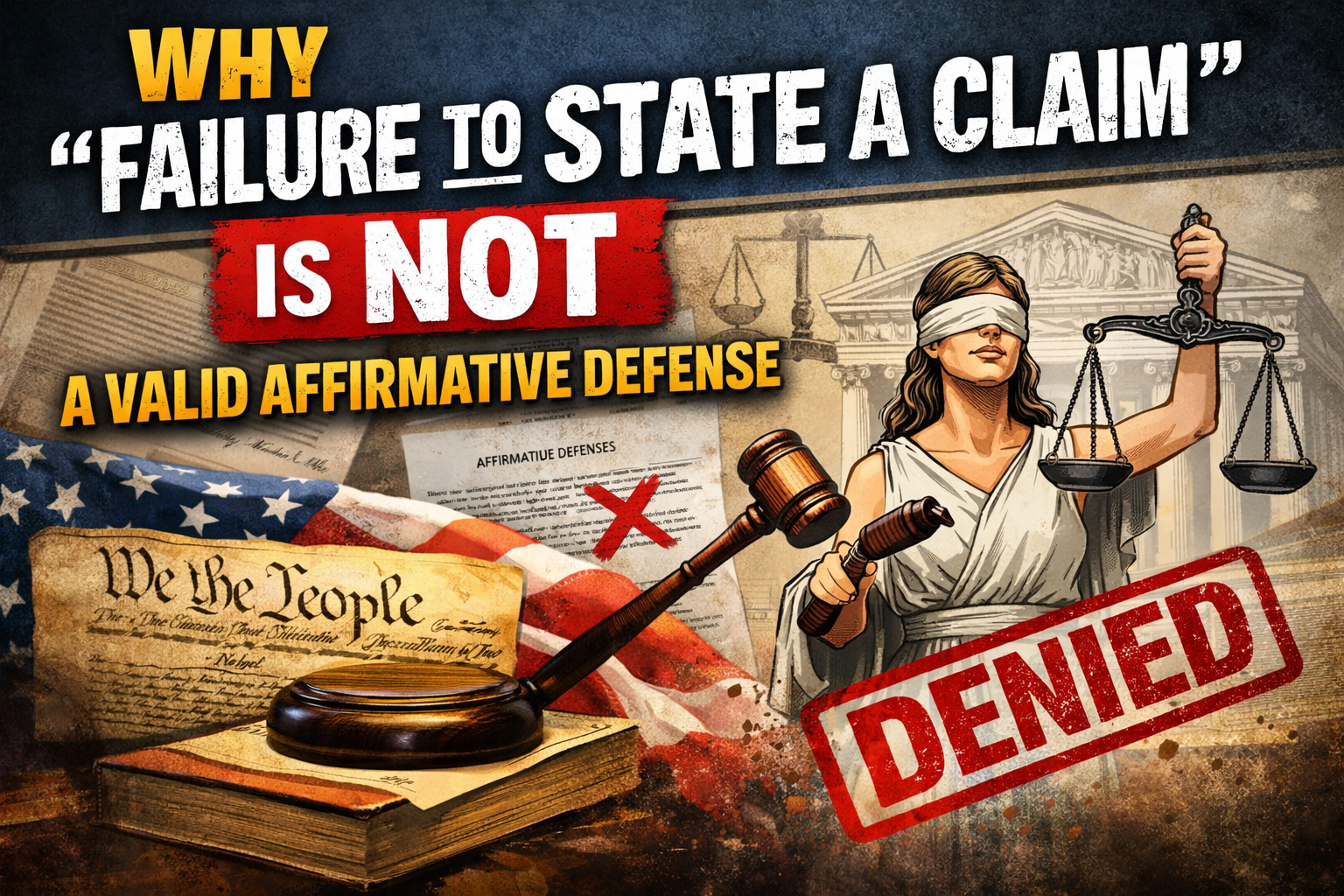
Failure to state a claim is not affirmative defense, learn why and the words to crush it in this workshop and learn to take back your power in court today!
Learn why many courts view “failure to state a claim” as improper boilerplate in an answer, how civil procedure rules treat the issue, and how to identify and challenge this defense when it appears in pleadings.
Failure to state a claim workshop: 149.00 Scheduled for 3-14-26 at 10.00 pm CST
Most people see the phrase “Failure To State A Claim” in a defendant’s answer and assume it is a powerful legal defense.
In reality, many courts recognize that this statement is not a true affirmative defense at all.
It is often inserted as boilerplate language with no facts and no independent legal basis. When used improperly, it does nothing more than repeat a challenge that should have been raised through a motion attacking the sufficiency of the complaint.
This workshop breaks down the legal structure behind this issue so you can clearly understand the difference between a real affirmative defense and a procedural pleading challenge.
When you understand this distinction, you begin to see why many courts consider the phrase “failure to state a claim” to be legally insufficient when it appears as a standalone defense in an answer.
Civil litigation is built on precise procedural rules.
When those rules are misunderstood or misused, it creates confusion for litigants and the court.
A true affirmative defense must introduce new factual matter that defeats a claim even if the allegations in the complaint are assumed to be true.
Examples of real affirmative defenses include:
Statute of limitations
Waiver
Estoppel
Release
Payment
Res judicata
Each of these defenses adds independent facts that avoid liability.
The statement “failure to state a claim” does not introduce any new facts. It simply argues that the plaintiff has not properly pleaded the elements of a cause of action.
Because of this, courts frequently recognize that the phrase is not actually a defense, but rather a procedural argument about the sufficiency of the pleading itself.
Understanding this distinction can dramatically change how you read pleadings and analyze the structure of a case.
This training is designed to walk through the issue step by step in a clear and educational format.
You will learn:
The legal definition of an affirmative defense
The difference between a defense and a procedural pleading challenge
Why many courts consider “failure to state a claim” improper when listed as a standalone defense
How civil procedure rules address challenges to the sufficiency of a complaint
How courts analyze conclusory defenses that contain no factual basis
Why boilerplate defenses appear so frequently in litigation
How understanding this issue can sharpen your ability to read pleadings and identify weaknesses in legal arguments
Most people assume legal pleadings are written with precision and accuracy.
In reality, many pleadings rely on template language copied from other cases. When you learn how to identify these boilerplate defenses, you begin to see that some arguments are included automatically without careful analysis.
Understanding the structure of pleadings gives you a stronger foundation for evaluating claims, defenses, and the procedural posture of a case.
This workshop focuses on education and legal structure, helping participants better understand how civil procedure works and how courts analyze the sufficiency of pleadings.
This workshop is designed for people who want to deepen their understanding of civil litigation and legal procedure, including:
Individuals studying civil procedure
Self represented litigants
Researchers analyzing court pleadings
Anyone interested in how courts evaluate claims and defenses
No prior legal training is required. The workshop explains the concepts in clear language so participants can follow the legal reasoning step by step.
Educational breakdown of the phrase “failure to state a claim”
Analysis of affirmative defense requirements
Explanation of how courts treat conclusory defenses
Practical understanding of pleading structure in civil litigation
This training provides an educational examination of civil procedure principles and how courts evaluate the sufficiency of pleadings.
The purpose of this workshop is to help participants move beyond surface level reading of pleadings and develop a deeper understanding of how legal arguments are structured inside a case.
When you understand the difference between a procedural motion and a true affirmative defense, you gain a clearer view of how litigation actually works.
And once you see that structure, many legal documents begin to read very differently.
Only logged in customers who have purchased this product may leave a review.





There are no reviews yet.